Ready to supercharge your solar system? Want your solar panels to shine, even on cloudy days? Let's dive into the world of MPPT charge controllers! These nifty devices are the secret to efficient solar setups.
Imagine this: You've got a powerful 250-watt solar panel, but are you getting the most from it? An MPPT controller can do wonders, optimizing your panel's performance by matching it with its Maximum Power Point (MPP). This means you can harness the full 250 watts and charge your battery effectively. It's like a precision tool for your solar setup.
Today, we'll explore MPPT charge controllers, uncover how they work, their fantastic benefits, and whether they suit your solar setup. Buckle up to maximize your solar panel's potential!
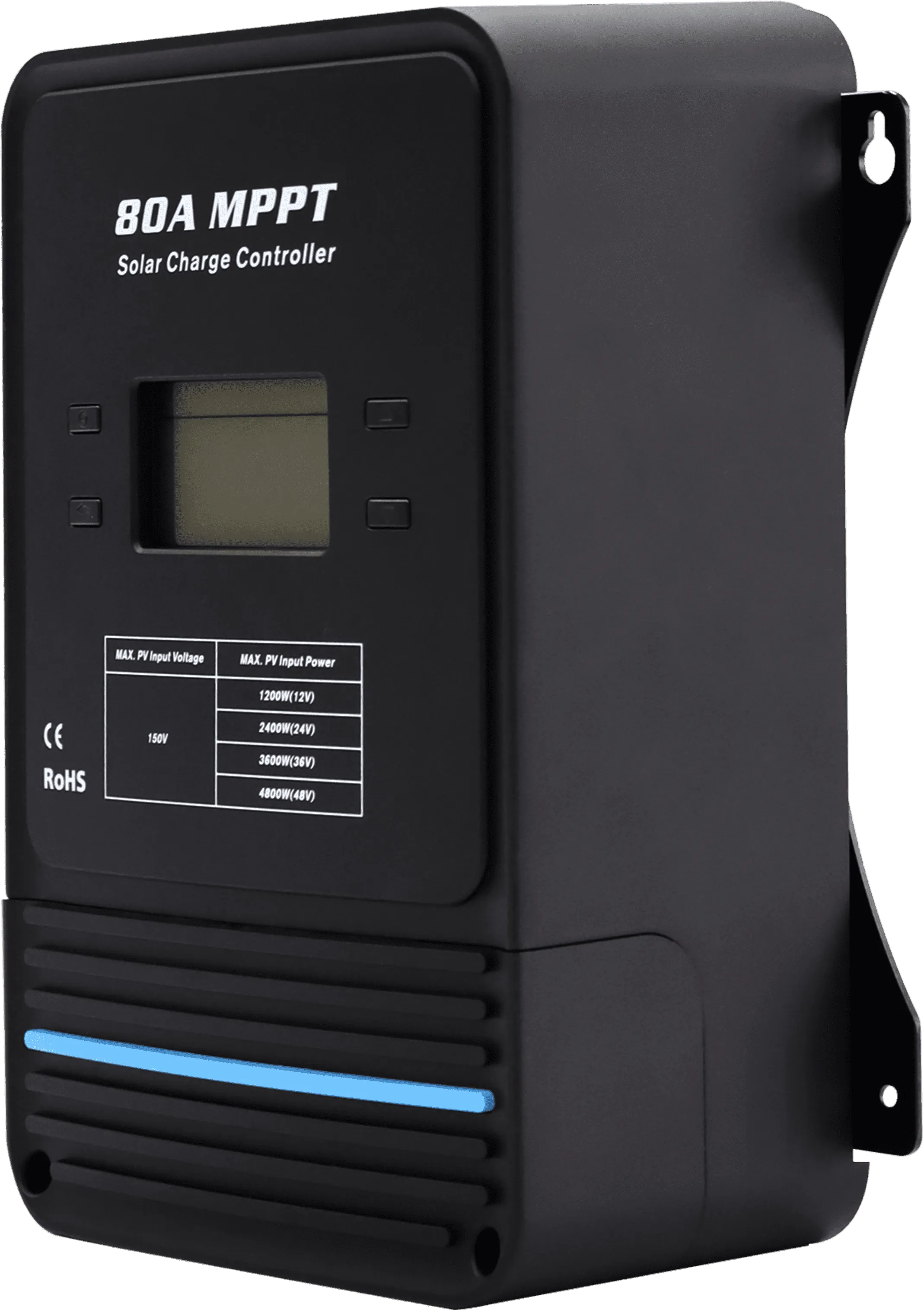
An MPPT (Maximum Power Point Tracking) charge controller is an essential component in a solar power system, particularly for off-grid and grid-tied solar installations. Its primary function is to optimize the energy harvesting efficiency of solar panels by dynamically adjusting the electrical load to ensure the panels operate at their maximum power output, known as the Maximum Power Point (MPP).
How MPPT Charge Controllers Work?
MPPT charge controllers serve as DC-DC converters, offering an advantage over traditional PWM controllers in terms of both charge current regulation and voltage conversion. To illustrate the significant efficiency improvement they bring, consider this example:
With a 250-watt solar panel, an MPPT controller optimizes the panel's operation by aligning it with its maximum power voltage (Vmp). This adjustment ensures that the controller receives the full rated power of 250 watts.
The controller subsequently delivers the power to the battery while adjusting the voltage to match the battery's 12-volt requirement. However, the current output increases to 20.8 amps, enabling the utilization of the panel's full 250-watt potential. (12 volts x 20.8 amps = 250 watts). This demonstrates the remarkable efficiency gains achieved through the MPPT controller's voltage and current optimization.
Enhanced Power Utilization:
When integrated into a suitably dimensioned solar power system, transitioning to an MPPT controller can yield a notable boost in efficiency, with potential gains of up to 30%. This efficiency enhancement becomes even more substantial in cases where the solar panel voltage significantly exceeds that of the battery, as illustrated in our previous example.
Optimal Performance in Overcast Conditions:
The MPPT controller's maximum power point tracking capability is particularly advantageous in regions prone to cloudy or overcast weather. These conditions cause fluctuations in the solar panels' maximum power point throughout the day, and the MPPT controller excels in adapting to these variations.
Ideal for Large-Scale Systems:
The advantage of harnessing an additional 20-30% of power becomes progressively more beneficial as the scale of your solar system expands. Consequently, MPPT controllers are often most suited for larger systems and may not offer as compelling benefits for smaller, less intricate configurations.
How to Choose the Right MPPT Charge Controller
Choosing the right MPPT (Maximum Power Point Tracking) charge controller is essential for the efficiency and safety of your solar power system. To make an informed choice, you should focus on the three primary ratings of an MPPT charge controller:
Battery Bank Voltage (V): The first rating to consider is the voltage of your battery bank. Ensure that the charge controller you select can support the voltage of your battery bank, whether it's 12V, 24V, 36V, or 48V. Using a controller that matches your battery bank's voltage is crucial for the proper functioning of your solar setup.
Solar Panel Input Voltage (V): The second crucial rating is the maximum input voltage that the charge controller can handle from the solar array. This is the most critical rating, as not matching your charge controller's input voltage requirements can lead to damage and void its warranty. This rating is typically provided as a range (e.g., 20-150V) or as a maximum voltage (e.g., 250V). It's essential to avoid exceeding the controller's maximum input voltage, as this could permanently damage the controller. Ensure that your solar array's voltage meets or exceeds the charge controller's requirements for safe and efficient operation.
Output Current (A): The third primary rating you should consider is the charge controller's output current, typically expressed in Amperes (A). To determine if a particular charge controller is suitable for your system, divide the total wattage of your solar array by the voltage of your battery bank. For example, if you have a 2000W solar array and a 36V battery bank, your calculation would be 2000W ÷ 36V = 55.6A. The rating of the charge controller should be at least 55.6A to ensure it can handle the current produced by your solar array. For optimal performance, the total wattage of your solar array should not exceed 15% of this rating, allowing your solar array to charge your batteries effectively throughout the day without overloading the charge controller.
Are MPPT Solar Charge Controllers Worth it?
The answer to whether a major purchase is worth the cost depends on the amount you use, the type of need you have, and how much the options differ from one another. You need to determine if the extra cost over time is worth the benefits, such as increased energy production, from an MPPT controller.
If you have a minimal system, such as a River Pro solar generator, the answer may be no. In the same vein, MPPT controllers may not provide a significant enough advantage for users who rarely encounter rainy or cloudy weather, since they are fine-tuned and frequently adjusted. You might not see the savings you would eventually expect from using an MPPT charge controller until you gain a significant amount of extra power.
In the absence of such circumstances, an MPPT solar charge controller offers significant advantages and pays for itself over time. It allows you to maximize your solar array's performance, avoid energy loss, and maintain peak performance all year long.
A MPPT solar charge controller gives you a more rapid return on investment. The more efficiently you generate and store energy, the faster your initial investment will pay off.
Helios New Energy Co., Ltd
Helios New Energy Co., Ltd. stands as a high-tech enterprise dedicated to the research, production, and promotion of solar solutions. Our primary focus lies in the realm of solar DC charging, lighting, and various PV energy storage applications. With years of expertise, our company is well-versed in solar DC charging technology, particularly in PWM and MPPT solar charge controllers. Our innovative concepts have been incorporated into the development of solar controller products, extensively utilized in standalone solar power systems, solar telecommunication stations, solar RV power systems, and other applications demanding a reliable solar DC charging source.


 Español
 Français
 Portugues
 العربية
 Deutsch
 日本語
日本語




 TEL
TEL E-Mail
 Address