A solar charge controller converts the raw energy from a PV solar panel into a usable charge for the battery, also referred to as a solar regulator. Between the panels and the batteries, charge controllers act as converters for the mismatched voltages.
PV arrays vary in voltage based on temperature, light intensity, and other factors. Solar charge controllers are needed between your solar array and solar battery bank in order to regulate these voltage fluctuations. Batteries expect a specific voltage and cannot handle voltage fluctuations on their own.
What type of solar charge controller would be best for your array?
The Two Types of Solar Charge Controllers
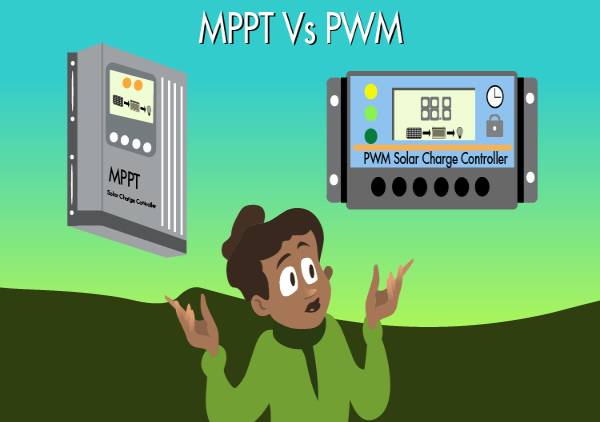
When setting up a solar power system, one of the critical decisions you'll face is choosing the right solar charge controller. There are two main types: Maximum Power Point Tracking (MPPT) and Pulse Width Modulation (PWM). While both serve similar functions, they differ significantly in terms of efficiency and application. In this article, we'll explore the distinctions between these two types of solar charge controllers to help you make an informed choice for your solar energy system.
MPPT (Maximum Power Point Tracking) Solar Charge Controllers
Efficiency and Innovation:
MPPT charge controllers utilize advanced technology to maximize the energy harvest from your solar panels. They achieve this by continually tracking the "maximum power point" of the connected solar array, optimizing both current and voltage. Unlike other charge controllers, which may waste excess energy generated by the panels, MPPT controllers can convert this surplus into additional power for your batteries.
Recent Affordability: MPPT technology, while available for several decades, has only recently become affordable for homeowners. This affordability has led to its widespread adoption in advanced residential solar power systems. Some estimates suggest that using an MPPT controller can boost a solar system's efficiency by approximately 30%. MPPT controllers achieve this by increasing the amperage supplied to the battery through the conversion of excess voltage.
Ideal for Various Scenarios: MPPT controllers are the preferred choice for residential solar setups, particularly those involving multiple panels and PV arrays with higher voltage than the battery bank. Other types of controllers would squander the excess power in such situations.
Higher Initial Cost, Long-Term Savings: While MPPT charge controllers generally come with a higher upfront cost than PWM controllers, they offer long-term savings. Their ability to harvest more power from the same number of solar panels translates into efficiency and reduced operating costs over time.
Efficiency in Depleted Battery Situations: When batteries are nearly depleted and operate at lower voltage levels, MPPT controllers can convert the extra voltage into additional amps, effectively rejuvenating the depleted battery.
All-in-One Solutions: For those who find building their solar system step by step daunting, there are all-in-one bundles available. These bundles, such as the EcoFlow Power Kits, simplify installation. They include the battery, cables, distribution panels, and a power hub with a built-in MPPT solar charge controller. All you need to add are your required solar panels to start harvesting renewable electricity.
PWM (Pulse Width Modulation) Solar Charge Controllers
Cost-Effective Simplicity:
PWM controllers are an older and more cost-effective technology. While they are less efficient than MPPT controllers, they remain a practical choice for specific scenarios.
Charging Mechanism: PWM controllers regulate the energy flow to your battery bank, but they do so differently than MPPT controllers. They use "pulse width modulation," which gradually reduces the current during charging. When the batteries reach full charge, PWM controllers provide a trickle charge to maintain battery levels.
Voltage Compatibility: To use a PWM controller, your batteries and solar panels must operate at the same voltage. This limitation makes PWM controllers less suitable for large residential solar systems.
Energy Utilization: PWM controllers can only use the power generated up to the voltage of your battery bank, which is typically around 12V. Any excess power generated by the solar panels goes to waste. This stands in contrast to MPPT controllers, which can step down voltage and boost current for greater energy utilization.
Ideal for Simplicity: PWM controllers are well-suited for warmer climates where the efficiency "boost" provided by MPPT controllers may not be as beneficial. Their cost-effectiveness makes them a viable choice for smaller systems where investing in an MPPT controller may not be justified.
What to Look for When Choosing a Solar Charge Controller
Now that you're familiar with the types, let's explore the critical factors to look for when selecting a solar charge controller:
System Voltage Compatibility:
Ensure the controller is compatible with your solar panel and battery bank voltage. Most controllers support 12V, 24V, or 48V systems.
Current Capacity:
Determine the maximum current rating of the controller. It should match or exceed the current output of your solar panels.
Efficiency:
Consider the efficiency of the controller. MPPT controllers are generally more efficient than PWM controllers, especially in non-ideal conditions.
Temperature Compensation:
Opt for a controller with temperature compensation if you live in an area with significant temperature variations. This feature helps optimize battery charging.
Load Control:
Some controllers offer load control functionality, allowing you to power DC loads directly from the controller. This can be useful for remote installations.
Protection Features:
Look for controllers with built-in protection mechanisms, such as overcharge, over-discharge, short-circuit, and reverse polarity protection.
Display and Monitoring:
Controllers with clear displays and monitoring capabilities provide valuable information about your system's performance.
Brand and Warranty:
Choose reputable brands with a track record of reliability. Check the warranty to ensure adequate coverage.
Conclusion
Once you have understood the difference between the two kinds of charge controllers, you can go out and purchase one of your own. In order to make the decision easier, you have to decide what the amp rating of your controller should be. You can make this decision easier by buying a controller rated at a higher power rating than what your solar array will provide.
Helios New Energy Co., Ltd stands as a cutting-edge technological enterprise specializing in the research and development, manufacturing, and promotion of solar solutions. Our primary emphasis is on solar DC charging and various PV energy storage applications. With extensive expertise in solar DC charging technology, our company has particularly excelled in the design and production of PWM and MPPT solar charge controllers.


 Español
 Français
 Portugues
 العربية
 Deutsch
 日本語
日本語



 TEL
TEL E-Mail
 Address